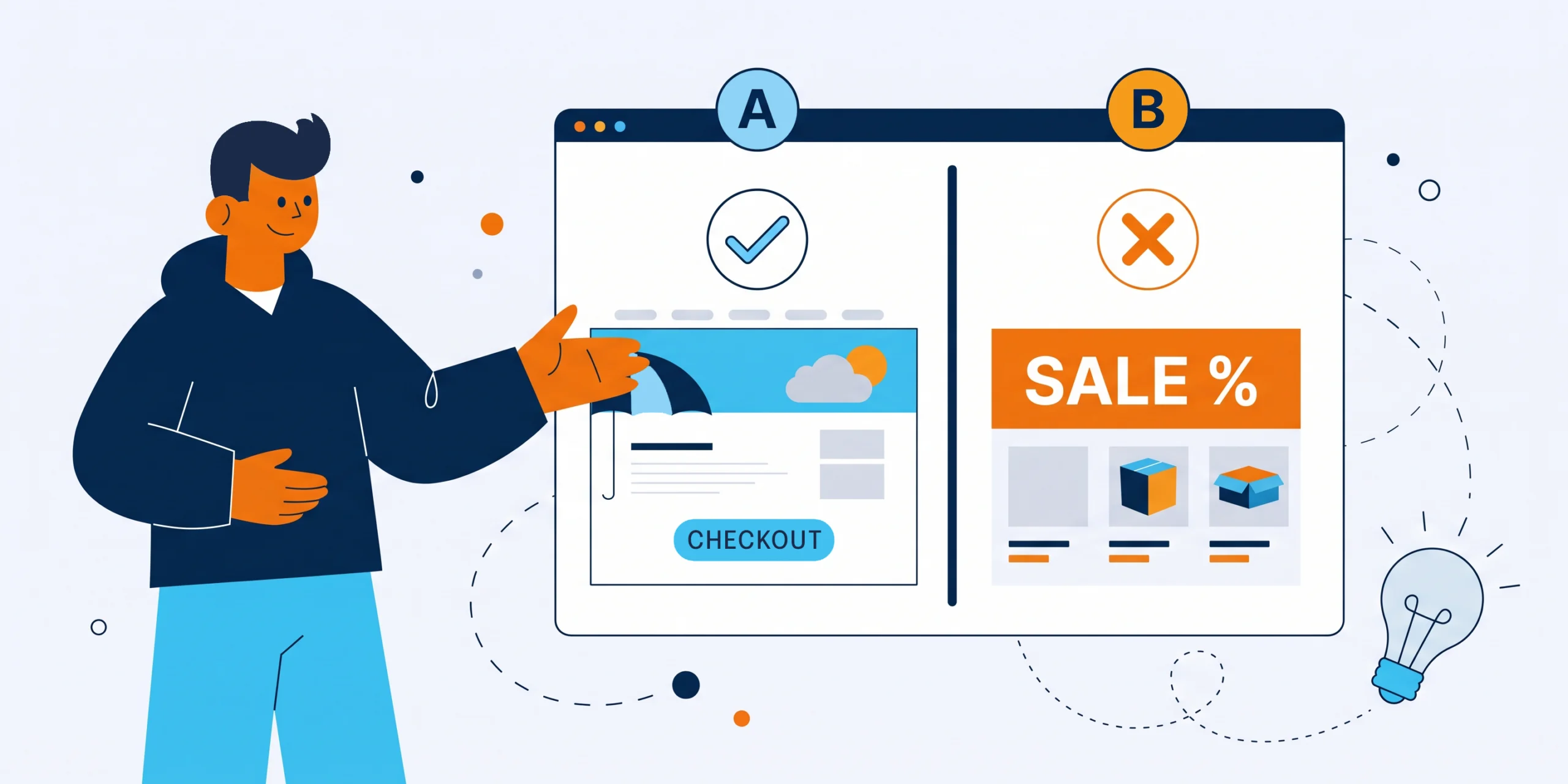
In everyday e-commerce, teams face constant pressure to deliver green numbers and instant uplifts in every reporting cycle. This often leads to a familiar, counterproductive pattern: campaigns that fail to move the needle statistically get framed favorably as a “positive trend,” while clear losing variations quietly disappear under the rug.
This mindset is risky. Defining digital experience optimization solely by a “winning” badge rewards statistical noise and wastes valuable traffic. For e-commerce managers and conversion rate optimization (CRO) teams, it is time for a shift in perspective: sustainable revenue growth isn’t driven by raw win rates, it is driven by high-density insights.
In this guide, discover why solid neutral results and definitive losers can be your most valuable learnings, and explore key rules to protect your testing program from costly false wins.
The True Value of a Clean Loss
An A/B test or e-commerce personalization concept delivers genuine strategic value to your online store in only two scenarios:
- The variation is a proven winner: A clearly defined primary KPI (such as conversion rate, average order value/AOV, or checkout completion rate) shows a statistically significant uplift over a complete test duration.
- The variation is a proven loser: Performance drops measurably or clearly underperforms against the control group.
Why is a definitive loss just as valuable as a winner? Because it proves, in black and white, which assumption about your target audience missed the mark. You avoid burning resources on dead ends, protect your brand from ineffective customer experiences, and can confidently close that hypothesis.
The only outcome that truly costs your store money is ambiguity: campaigns that consume high volumes of traffic for weeks without proving measurable impact or clear learnings.
E-Commerce A/B Testing: The Three Sins of Data Analysis
To generate reliable data-driven insights, every optimization team needs non-negotiable ground rules before launching a campaign:
- Avoid metric hopping: If your primary goal (such as conversion rate) stays flat, retroactively reinterpreting a secondary vanity metric, like scroll depth or clicks, as a “win” invalidates the experiment.
- Resist early test termination: Stopping an experiment after three days simply because the trend line looks promising produces random chance, not statistical significance. Valid confidence levels require sufficient time and adequate traffic to smooth out day-of-week fluctuations.
- Stop post-rationalizing: Discovering that a variation “performed great among new users on rainy days” is not a validated test outcome. At best, it serves as an exploratory hypothesis for a structured follow-up test.
Cluster Hypotheses Instead of Chasing Isolated Fixes
Instead of deploying disconnected UI tweaks, organize your experiments into overarching strategic clusters, such as cart-level trust building, dynamic cross-selling on product detail pages, or automated retargeting for hesitant visitors.
When a focus area consistently yields conclusive answers (positive or negative), you gain a deeper understanding of your user behavior step by step. If a cluster yields inconclusive results for months, deprioritize it and reallocate resources toward higher-impact levers across the customer journey.
A structured roadmap also shields teams from internal guesswork: gut-feeling feature requests can be systematically evaluated by whether they support established testing themes or merely create noise.
Insights in Action: The mydays Success Story
A rigorous, hypothesis-driven testing strategy directly unlocks measurable revenue, as demonstrated by experience gift provider mydays:
Instead of altering random shop elements, mydays targeted alternative product recommendations and optimized the mobile user experience around concrete customer intent. The outcome of their continuous testing program: a measurable 21% increase in mobile conversion rates.
Smart Technology Unlocks Potential – How trbo Empowers Your Team
Successful conversion optimization rarely stalls due to a lack of ideas, it stalls because of technical bottlenecks, slow deployment cycles, and inaccurate data tracking. This is where trbo delivers:
- A/B & Multivariate Testing: Test dynamic content, promotional banners, on-site overlays, and AI-powered recommendations in real time with automated statistical significance.
- Actionable Performance Insights: Track core commercial KPIs, including conversion rate, average order value (AOV), and customer engagement, within a centralized platform.
- Dynamic Audience Segmentation: Deliver targeted digital experiences to specific customer segments (e.g., new vs. returning shoppers or regional audiences) without opening complex IT tickets.
- Built-In Protection Against Data Misinterpretation: Avoid premature conclusions with clear, reliable analytics surfaced directly in the trbo platform.
The platform handles the technical heavy lifting, freeing your team to focus on the key strategic question: Which core business hypotheses deliver the greatest impact?
Conclusion: Every Valid Test Result Is a Win
Move past the pressure of manufactured uplifts. Clear losers and clean neutral results are not failures, they safeguard your online store against expensive mistakes, flawed redesigns, and wasted ad spend. Turn verified insights into your e-commerce team’s most valuable currency.
Ready to ground your testing and personalization strategy in reliable data? Discover how trbo’s integrated A/B and multivariate testing engine enables data-backed decisions that sustainably scale your conversion rates.
👉 Schedule your personalized demo with our optimization experts today!
FAQs
- Why is a negative A/B test result just as valuable as a conversion uplift?
A definitive losing variation delivers concrete insights into customer behavior. It documents precisely which messaging, offer, or UI change fails to resonate with your audience. This prevents expensive rollouts, protects brand equity, and allows you to reinvest testing capacity into hypotheses with higher conversion potential. - How early can you conclude an e-commerce A/B test?
Never end an experiment prematurely based on early positive trends. Tests require adequate sample size, conversion volume, and complete business cycles (typically full seven-day periods to account for day-of-week purchase patterns) to reach true statistical significance. Intelligent testing platforms like trbo automatically identify when data reaches statistical validity, protecting teams from premature calls. - What is the difference between a false win and a genuine A/B testing success?
A genuine win achieves statistically significant uplift across your pre-defined primary KPIs (such as conversion rate or AOV) over the full duration of the test. A false win occurs when flat primary metrics are ignored in favor of arbitrary secondary metrics (like button clicks or scroll depth) or hyper-niche audience segments cherry-picked after the fact to manufacture a success story.