The demands on e-commerce teams are constantly growing: maintaining products, managing campaigns, reducing return rates, and boosting conversion rates all at the same time. But to know where the real levers lie within your shop, there is no way around direct customer feedback.
In this article, you will learn which surveys every e-commerce team should continuously run on their website and how to implement them in just a few minutes using AI Prompts—completely without any IT effort.
E-Commerce Use Cases Every Online Shop Should Use Immediately
To uncover gaps in the customer journey and protect revenue, these three feedback scenarios should not be missing from any online shop:
|
Use Case |
When (Trigger) |
Goal |
Added Value |
|---|---|---|---|
|
1. Post-Purchase NPS Measurement |
On the thank-you page right after a successful checkout. |
Measure customer satisfaction at the peak moment of purchase joy (Net Promoter Score) and gain valuable insights into the ordering process. |
Intercept criticism directly in your shop before it lands on public review platforms—and systematically motivate enthusiastic customers to leave reviews. |
|
2. Exit-Intent Survey |
As soon as a user has filled their cart and attempts to leave the page. |
Determine the exact reason for abandonment (e.g., “Shipping costs too high”, “Preferred payment method missing”, or “Unclear product questions”). |
Immediate insights to optimize the checkout conversion rate and eliminate purchasing friction. |
|
3. Feedback on New Features |
After a relaunch, design change, or introduction of new services (e.g., express shipping, installment payments). |
Gather direct feedback from users on whether the updates are clear and well-received. |
Quickly test hypotheses without having to wait for lengthy A/B test results. |
The Hurdle: Why Customer Surveys Often Fail to Get Implemented
Although these use cases are critical to success, practical implementation often fails due to a lack of developer resources, rigid feedback tools, or excessive manual setup effort.
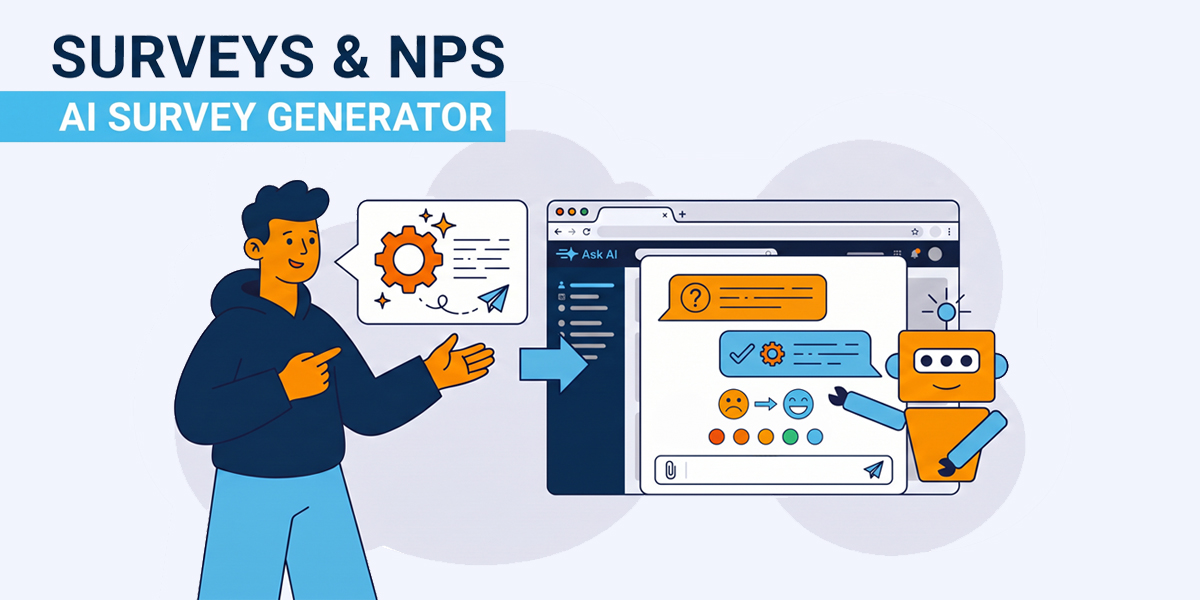
With trbo, this hurdle is a thing of the past. E-commerce and marketing teams can now create user-specific surveys and NPS layers on their own websites in seconds—simply via AI Prompt.
From Idea to Finished Survey: How Simple It Is with trbo
1. The Initial AI Prompt
A precise prompt is all it takes to map even complex logic. Here is a practical example:
Prompt Example:
“Create a 2-step exit-intent survey for users who want to leave their cart. Step 1 asks for the reason for abandonment: ‘Why are you leaving your shopping cart?’ with the radio options ‘Shipping costs too high’, ‘Preferred payment method missing’, ‘I am just comparing prices’, and ‘Other’. Step 2 shows conditional content: For ‘Shipping costs too high’, display a voucher code for free shipping. For all other options, display an open feedback text field for comments, along with the submit button. Each step needs a clear title, a modern design, and a dismissible X in the corner.”
2. Fine-Tuning via Follow-Up Prompt or Manually
After initial generation, the layer can be flexibly adjusted:
- Via Follow-Up Prompt: Want to sharpen the tone or questions? Simply type: “Make the tone more casual” or “Add a thank-you banner to Step 3”.
- Manual Adjustment: Naturally, you can also fine-tune colors, fonts, buttons, and layout manually in the familiar trbo editor to align the design precisely with your shop’s brand voice and CI.
Conclusion: Greater Customer Understanding Without IT Effort
User feedback in e-commerce doesn’t have to be complicated or time-consuming. With AI-assisted creation of surveys and NPS layers in trbo, e-commerce teams can build targeted, visually appealing feedback overlays in minutes—without any coding knowledge.
Want to see how fast you can launch your first customer survey live with trbo?
Book a demo now and experience trbo AI in action!